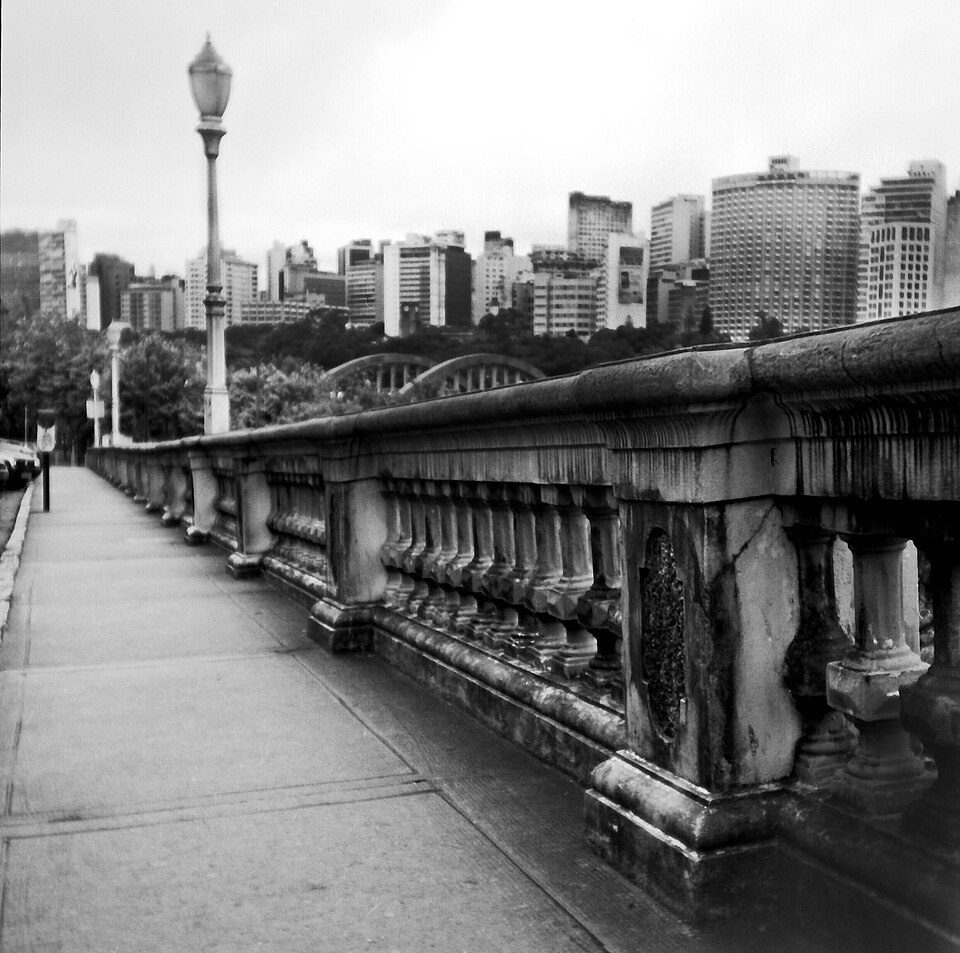
I rented an office on the corner of Rua Norita and Rua Quimberlita. Venetian blinds on two sides kept out the worst of the sun. Three days later the sill was black with dead flies and I’d not seen a hair of Harry Gawston.
Belo Horizonte looks like a movie. Wide streets, men in sunglasses. I might be in Los Angeles for all I’d know. The women look you right in the eye as they go by.
I was smoking a Craven and reading last week’s news in a damp Daily Mirror when a tall light-heavyweight tapped the door and walked in. Perhaps forty-five or fifty, sleeves rolled back, face bottom-heavy and clean shaven, dark tan, blonde hair in an army cut. Miner’s boots, miner’s hands.
‘Mr Markson?’
‘Yep.’
‘You left a card. At the office.’
I’d left lots of cards in lots of offices. A lot of secretaries were going to call me just as soon as they heard anything.
‘Gladstone?’
‘That’s the one.’
Gladstone Mineral. The biggest British mining concern in the state. Employed around three thousand men in mines to the south-east, most of them Scots and Ulstermen. This man was a Glaswegian or anyway something like one.
‘You’ve got something for me? Some information?’
‘Do you pay?’
‘By the word, like The People’s Friend.’
‘What?’
‘I’ll give you something if it’s good information.’
‘I was drinking in a bar with Harry Gawston the night of the USA match.’
‘Okay.’ I picked up my paper and shook another fag out of the packet. ‘Thanks for trying. My secretary will show you out.’
‘What?’
‘I don’t blame you for having a crack. Next time do your research, that’s all.’
He called me a few bad words. I read the sports page until he went away. A Field Day For Our Athletes. Stars Not Missed At Wigan. When he banged the door the blinds all went shhhh, shhhh.
I tossed the paper back on my desk and pulled open the desk drawer. Took out a bottle and a glass and Harry Gawston’s file. Brazilian rum. It was nicer with ice but I didn’t have any. I flipped open the file. Harold John Gawston. Born in Halifax, January 9, 1918. Thirty-two years of age. A gas engineer by training. Spent the war in Norway and Holland mostly. Applied in the summer of 1949 to join up with the Wesleyan Reform Union Mission in Belo Horizonte, Brazil. He’d been accompanying his mother to Temperance Society meetings since he was eight years old. Father a lay preacher.
Wherever he was he wasn’t out drinking with bloody goldminers.
I closed the file and finished my rum. Then I put on my hat and went out into the street, where the sunshine hit me like a bus.
*
Stan Coates was from south Leeds. His bar was dark and cool. I liked that about it. Stan was built like a paperclip and wore thick-framed glasses. I’d found him on a tip-off from back home. He’d sold up and come out here years ago, riding the latest goldrush, minerals, emeralds, metals, whatever it was that time. He’d bet no-one ever went bankrupt selling beer to working men in eighty degree heat. It was paying off, or anyway he was still here.
‘They got hold of a local stringer for the Daily Herald. He was terrified. He thought they were going to hang him from a lamppost or throw him in the river.’ He thumbed a bead of sweat from the side of his nose and took a mouthful of beer. ‘But no, all they wanted was to know why Matthews didn’t play. Had he an injury? Was he being held back for later? Had there been a falling-out? Was the fix in?’
‘Bloody hell.’
‘The poor kid hadn’t a clue.’
‘Do you know why he didn’t play?’
‘The brass, the generals, they don’t know a fucking thing about the game, Mr Markson, pardon my Portuguese. When did they ever? Same old story.’
I wondered if he’d served. Some men say they can always tell. They say they know the ‘look’. It’s wallop. There’s no ‘look’. People aren’t that easy. There’s a thick scar on my right hand. Maybe I got it at Arnhem or in Malaya. Maybe I was clumsy with a wood saw. It’s no different with other kinds of scars.
‘The thing to understand,’ Coates said, ‘is that the players can fly home to England. These lads have to stay here. Brazilian bosses, Brazilian coworkers. They’re getting it in the neck left right and centre, these poor buggers. ‘Kings of Soccer’. All this.’
‘Seems a bit childish.’
‘That’s football for you.’ He pulled a handkerchief from his pocket and wiped the left lens of his glasses. ‘Wasn’t half funny when Brazil got beat in the final though. The faces on them. Who’s kings of soccer now? Bloody Uruguay that’s who.’ Chuckled to himself. ‘You’d think someone had died. That’s football for you,’ he said again.
I was never keen on football. At my school we played rugby league in the winter. If anyone asks I say I’m a Huddersfield Town man. A lot of fellows don’t trust a man who doesn’t follow football.
If they ask me for my favourite player I say ‘the big man’. Usually turns out that they like the big man too. Or they think the big man’s a sack of shite and they wouldn’t have paid bloody tuppence for him. Either way they know I’m one of them.
‘Do you know a big Glaswegian who works for Gladstone?’
‘You’ve narrowed it down to maybe four or five hundred men.’
‘Middle-aged. Blond. Not clever but an eye for the main chance.’
‘On a Friday night I could shout ‘Robertson!’ in here and fifty fellers matching that description would turn their heads. Come on.’
I laughed. Stood up, leaving an inch of foam in my glass and a few coins on the counter.
‘Does that cover the beer?’
‘Generously.’
‘What do you know about this Methodist lot?’
‘I know you’re making a mistake going there with beer on your breath.’
‘I’ll suck a mint. What are they like?’
‘I don’t see much of them, for obvious reasons. I had an aunty in that line back home. Lived in Saviletown. Here Be Dragons.’
‘Mrs Gawston seemed all right.’
‘Who?’
‘Wife of my missing.’
‘Oh, I daresay some of them are right enough, even if they are bad for business. And you’ve got to hand it to them coming over here at all, where if it’s not Catholics it’s blacks and savages.’
I shrugged. I didn’t feel I had to hand them anything. They could go where they pleased for all I cared. I’d sooner they left me alone, was the only thing.
And yet here I was, six thousand miles from home, going out of my way to track them down. I stepped out of Coates’s bar and hailed a taxi, a guttering pre-war DeSoto. I had the address of the Methodist Mission written on my packet of Craven. I read it out as best I could. The driver nodded and hit the accelerator and we took off like a V-2 rocket.
There’s a lot of city here. I’d thought, half an hour’s drive and we’ll be in the jungle. Half an hour on and there were still tramcars and shops, bars and parking meters, men in office clothes, women in dresses and hats.
Perhaps the bars were a little seamier here. Perhaps the suits and dresses were a little cheaper. Here and there a beggar rattled a can. When the taxi stopped a young brown lad ran up to the window with his hands cupped, saying things I didn’t understand. I handed him a coin as I climbed out. I handed the driver another sort of coin. ‘OK?’ ‘OK.’
The DeVoto thundered away. I crossed the road. The Methodists had taken over what looked like an old fire station. There was a sign in English and a sign in Portuguese. A man lounged by the red doors. Behind the mission wooded green hills rose up. A heavy bird flew from the treetops, shrieked once in the sunshine, and dropped away.
I was sweating and I wanted a cigarette. The man by the door looked me up and down and I looked him up and down. He was slender and athletic, about thirty, brown hair neatly parted to the left, acne scars on his cheeks. Carried himself well.
When we were both done I put out my hand. ‘Andrew Markson. I’m a private detective. I’ve come from England. I’m looking for a man named Harry Gawson.’
He shook my hand and said, ‘Ah, the mysterious Mr Gawson. I’m afraid you’ve had a wasted trip. You won’t find him here.’
An educated accent.
‘But you know him?’
‘He was here. Fleetingly. We were expecting him on the twenty-fifth. He turned up on the morning of the twenty-ninth. Nobody was here except a secretary. He told her he’d come back the next day.’
‘And he never did?’
‘He never did. We haven’t heard a thing from him. A pity, as from his letters he seemed a very promising young man.’
‘Did he tell the secretary where he was going?’
‘Would hardly have helped if he had. She hasn’t much English, I’m afraid.’
‘Could I speak to her? What’s her name?’
‘Oh, no, I don’t know her name. But she isn’t here today, anyway. I’m minding the shop by myself. If you’d like to leave a card – ?’
I gave him a card. My thumb left a sweat print on it. I wondered when he was going to offer me a cold drink or a lift back to town. He didn’t. He just said ‘Well, goodbye.’
I asked him his name and he said ‘Smith’. As he went inside he said something I didn’t catch. It might have been ‘God help you’. I turned around and started to look for a way back to dear old Rua Norita.
*
By seven o’clock it was a little cooler and almost dark. I ate an omelette and drank a bottle of beer. Then I set a chair and standard lamp out on the concrete balcony of my apartment. I poured a glass of rum and settled down to read Harry Gawson’s letters.
I censored enough letters in the war. It isn’t a hard thing to get used to.
He was a good boy, Harry. You could see it in his letters to his mother, his cousins, his wife. The religion ran deep in him. Not like some.
Nowadays when you say someone’s a good boy or a good man it always sounds like an innuendo or the punchline to a joke. But I think he was. Or I think he wanted to be. It amounts to the same thing.
Now and again a moth or a beetle would land on one of the pages and I’d have to shoo it away.
Harry wasn’t what you’d call open. Not even with his wife. Not even back when she was plain Miss Eccup. He wasn’t emotional. But neither did you get the impression that he was hiding something. There was one thing. One of Harry’s friends. Lawrie Bullimore in Marsden. I didn’t have Harry’s letters to him but I had Bullimore’s letters back. I’d have to speak to Mr Bullimore. Could you even call Mardsen from Brazil? It was too late tonight anyway. Well past midnight back home. I made a pencil note in a margin and set the letters aside.
I’d liked Mrs Gawston. Late twenties, sort of raw-boned. A deep voice for a woman. Hair tied up. No hat. We met in Sullivan’s office. Sullivan introduced me. ‘Our best man.’ He was reassuring, Teddy Sullivan. He reminded you of an uncle or a good schoolteacher. She said she was terribly worried: ‘Terribly, awfully worried about Harry.’ A letter had arrived from the Belo Horizonte Mission. Dear Mr Gawson, where the devil are you? That was the gist of it. Of course as far as poor Kathleen Gawston here knew he’d been with them saving souls since late June. The letter was dated July 22. That was when she called Sullivan.
Any friends out there in Brazil? Any reason you can think of he might be lying low? We hate to ask, Mrs Gawston, but is there anyone who might wish Harry ill, any reason he might have for changing his plans, has he been in any kind of trouble at home? It pains us to suggest it, Mrs Gawston, but might Harry have any private interests? By which we meant vices.
She smiled crisply and said anyone would think he was one of those fugitive Nazi generals. Then she said no, no private interests – ‘as far as I know, though we’re all only human, Mr Markson, God knows’.
Harry always wrote to his wife if he was away from home with work or on church business. It was mostly chit-chat. He liked to tell her about his work on the gas mains. Sometimes there was stuff about God or the bible. In one letter, dated June 1948, Harry wrote about papering the box room for ‘when the little one arrives’. That never came up again. More than anything it was dry talk about friends and neighbours and relatives.
I picked up the file of letters again. Folded in the manila cover was an envelope Mrs Gawston had given to me to give to Harry if I found him. Sullivan and I had steamed it open over the electric kettle as soon as she left the office. A lead is a lead and you can’t be shy in this game.
We knew our business and we’d left no sign. She’d never know. She might guess but she’d never know.
Anyway it didn’t give us much.
I poured another drink and looked out at the towering lights. The concrete made clean lines against the dark sky. Long automobiles droned by far below. I could hear some jazzy sort of music from some sort of bar. What were you doing here, Harry? They don’t need you. They don’t need your milltown religion. Look at the place.
This Bullimore. His letters were mostly about the church and music and trains. Just two pals with similar interests. Three times though in letters from December 1949, March 1950 and April 1950 he’d used a funny phrase. ‘That thing of ours’.
I went to bed around midnight, by the Belo Horizonte clocks.
*
The next day was overcast and I was glad of it. I washed and shaved and went over my notes while my coffee boiled. By nine I was in the Western and Brazilian telegraph office, cabling my enquiries to Sullivan back home. I had another cup of coffee and a chocolate turnover in a nice café while I waited for his reply. For ten minutes I felt like a holidaymaker. When Sullivan wired back with a number and work address for Laurie Bullimore I took a taxi to the city offices of Gladstone Mineral. If anyone could get a telephone call through to England from here it was Gladstone.
A sweet Portuguese girl on the front desk spent twenty minutes telling me no, they couldn’t. I thanked her and went to find a bar.
The barman was a local. He had decent English or anyway his English was better than my Portuguese. I drank a beer and we talked about the football. He laughed at me – ‘USA!’ – and to be polite I pretended I minded.
Out of habit I turned the conversation to Harry Gawston. The barman didn’t get it. An Englishman? Here? Not in mining or minerals or steel? Not here for the Copa? ‘No. A missionary. A religious man.’
He laughed.
‘An angel.’
‘Something like that.’
He made a face and shook his head. No angels here, I suppose he meant.
I thought about the religious life. About denial. I knew some men would say it’s no good, keeping things inside you. They won’t stay there, these men say, however hard you try. However much you want them to. Sooner or later they come out in ways you don’t expect.
I don’t think that’s true. I think some things can stay inside. I hope some things can stay inside.
After about an hour and another beer in the bar I headed back to Western and Brazilian. Sullivan had got through to Laurie Bullimore at work. COLD LEAD. FOOTBALL PAL. NO MUSTARD. SULLIVAN. Not Sullivan’s idea of mustard but I’d take it. I found a telephone and called Stan Coates’s bar. No, he didn’t have a number for the Herald stringer. No, Stan wasn’t at the match, he was working. It’s possible he might remember a face but he was two streets away from the Independência, remember, he had ten thousand drunk Brazilians in that night and five hundred Englishmen drowning their sorrows.
I found another taxi. Sullivan would have my guts when I put my expenses in. I showed Stan the only photograph I had. Harry in a pullover and shirt, smiling with church pals. A thin, nondescript young man. All Englishmen look the same here, Stan said, passing the picture back. All sweat and sunburn.
I used Stan’s telephone to call the Gladstone switchboard. After ten minutes going round the houses I got hold of the secretary I’d left my card with. I told her who I was.
‘You were going to call me as soon as you heard anything.’
‘You didn’t answer the phone.’
‘Did you call?’
‘No, because I never heard anything.’
One of these London girls who think they have a sense of humour. We to-and-froed for a bit. She said I sounded handsome and asked if she could call me. I said she could look me up in Huddersfield any time. Eventually I brought us round to the card I’d left. Who had she given my name to? Some miner, she said. One of the Scottish boys from up at Morrovelho. Could I cadge a lift out that way? She gave me a street name out beyond the Contorno. Three trucks go from there at six every day, she said. They take casual labourers out to the mines.
They might let you on, she said, if you stick out your thumb and bat your eyelashes.
*
I felt like I was in the army again. There were twenty-six of us in the back of a dump truck, labouring into the hills at the back of a three-vehicle convoy. The sun was out again and the temperature was in the eighties. I’d loosened my tie. The rest wore undershirts and cropped trousers. They were mostly coloured and mostly young. They talked between themselves, some in what sounded like Portuguese, some in other languages. None of them had much English. ‘USA’, one of them said with a smile when I clambered on. I raised two fingers at him. I thought I heard one of them say ‘Tom Finney’. That was all I got. It took just short of three hours to reach the minehead.
The convoy pulled in in smart formation. A white man in a blue fedora was waiting by a group of prefab sheds. He had a clipboard and a walking stick. Everyone tumbled out. The air smelt of dust and flowers. The landscape was scrub, low trees, yellow earth. I couldn’t see the mineworkings from here. I could hear the zoo noises of big diesel engines. The sky was painfully blue above the dust haze.
I waited, leaning against the truck I’d come up in, until the fellow in the fedora had finished with the other men. I smoked a Craven until he noticed me.
‘What are you?’
I explained.
‘Do you know the man’s name?’
‘No, but I know he wasn’t in work on Tuesday afternoon.’
‘I could check with the overseer.’ He hovered, shifting his weight on to his stick and off again. He was a Scotsman, wiry, burnt, twitchy. ‘It’s a bit irregular.’
‘Would you mind?’ I had some US dollars with me. I passed him a five. ‘Is there somewhere I could wait in the shade?’
He looked at me, then closed one eye and looked at the sky.
‘You’ll find there’s some shade,’ he said, ‘the other side of that truck.’
‘Thanks.’
Instead I climbed into the cab on the driver’s side. It was close and stank but there was a shutter on the side window to keep out the sun. I pulled it as far as it would go and tried to settle down in the bony seat.
I woke up an hour later. The sun had gone behind grey clouds. My shirt was damp. The miner I’d kicked out of my office was in the seat beside me.
*
‘I was drinking. He wasn’t drinking. That man didn’t need a drink. He was on something else.’
He was OK once I’d apologised and given him a cigarette. His name was Purvey and he was from some town in Lanarkshire.
‘This was after the football match?’
‘Right after. There was me and a few pals from here. We found some bar. We wanted to celebrate. I mean nobody likes a Yank but at least they’re not English. And their lad McIlvenney’s from Greenock and Bill Jeffrey’s from Edinburgh. So we found the first bar that had whisky. Before we knew it this wee lad was in amongst us.’
‘You’d never seen him before?’
‘Never in my born days. But I’m a friendly fellow. Buy you a drink, young man, I says. He says no, like I’d slapped his face. But he was upset. More than upset.’
‘Was he angry?’
‘No. More like – heartbroken.’
I remembered what Coates had said. You’d think somebody had died.
‘Did he say much?’
‘Man he never shut up. I barely caught the half of it.’
‘What did he talk about?’
‘God. Of all bloody things. Losing his faith. Abandoned by God. Sufferings of Job. Why hast thou forsaken me. A whole lot.’
‘Where did you last see him?’
‘You know you could have heard all this on Tuesday if you’d forked out a bit of beer money.’
‘You’ll get paid, if this comes through.’
‘He took his shoes and socks off.’
‘He what?’
‘He took his shoes and socks off. He was shouting something but it was pretty rowdy by that time. We all went outside, it must have been two, three in the morning, we were due back at the mine in a few hours, and he come out with us, barefoot. I asked him, where are you going, where will you stay? He says the whole of the world is my home now or else nowhere is.’
‘And then?’
‘He ran off. Like a rabbit. It was funny. And all of us cheering him on like he was in the Olympics, away he goes up the street in his bare feet.’ He drew on his cigarette and laughed. ‘Quick, too.’
‘What direction?’
‘God knows, man. I think one of the boys kept his shoes and socks. They were quite nice.’
There was a tap on my window. I jerked up the blind. The fellow in the fedora, knocking with his stick.
‘This man needs to get back to work,’ he said.
‘Okay.’
I slipped Purvey a couple of dollars and we climbed down from the truck. A long way to come for not much. But not nothing, either.
‘If you wait an hour or so,’ fedora called over his shoulder, ‘one of the boys will be taking a truck back down.’
I found a patch of grass in the shade of a tree. I wished I’d brought my newspaper.
*
I thought it reminded me of Kirklees. The hilly farmland east of Huddersfield, south-west of Wakefield. Then I thought the sun must be getting to me. But the more I thought about it the more it did. The hills, the low trees, the grass kept short by rabbits or sheep. The tracks and marks of industry. No goldmines in Kirklees but work is work.
It was getting on for nightfall. I found him sitting on a rock. He was wearing someone else’s work shirt, twill trousers and nothing on his feet.
‘I thought there’d be jungles,’ he said.
I sat down next to him.
He said, ‘It’s all just countryside.’
It was the lad who drove the truck back down that got me here. Or got me halfway here and the rest I walked. Young lad, local. Pretty good English. First it was ‘USA, one-nil.’ Then it was: ‘Another funny Englishman riding in the trucks.’
There’d been another one a few weeks before. He said nothing. He had no shoes. ‘Not smart, like you.’ He didn’t laugh when they said ‘USA’. He didn’t do anything.
He jumped off the truck, the lad said, twenty miles short of the minehead.
I told him to stop the truck after twenty miles. The sun was out again. My neck was burnt. To the north the city was spread out for as far as I could see, shining like a lake or a coin. I thanked the lad and set off walking.
‘Other way he went,’ the lad shouted.
I thanked him again.
There were people out here. There were farms, houses, worksheds. I walked past a woman feeding hens and a mechanic outside his garage sweating under a Ford AA. I didn’t know if these were native people or Portuguese people or coloured people or what they were and I didn’t know how to ask. They seemed more or less like people everywhere. Every time I came across someone I said ‘English?’ or ‘white man?’ or I drew a circle with my finger around my own face. Harry Gawston didn’t look much like me but he looked more like me than he looked like them.
Around six out of ten people had seen him. I supposed he’d be hard to miss, this broken-hearted Englishman walking barefoot across the baked earth. Every time they said they’d seen him I asked them where and then walked where they pointed.
‘Please don’t tell me it was about the football.’
‘Of course it was about the football.’
Seven weeks he’d been out here. He was scorched and thin.
‘You should be dead.’
‘People are very kind.’
‘Do you want to tell me about it?’
‘Not really.’
‘Do you want to go home?’
‘I’d like a meal and a bath.’
‘Your wife’s been worried to death.’
‘I’m sorry,’ he said. ‘I’m very sorry about everything.’
He did tell me about it after all.
We’d both supposed, Sullivan and me, that Harry had come out here for the World Cup. It was the first thing we asked: which games does he have tickets for? None, she said. Harry doesn’t care for soccer. Thinks it’s a beastly business. He wants to work with the Mission.
Well the bit about the Mission was true enough. But the beastly business part was all Mrs Gawston. Apparently her big brother had got into a fight at a Sunderland match before the war and had his cheekbone broken by a riveter.
Harry had grown up a football nut but after he’d married Kathleen he’d sworn off football like some men swear off drink or the horses. Never again, love. I promise.
There’s your private interest.
‘I chose the church. But in fact I never saw or rather never felt there was a great deal of difference between the two. Football crowds can be a bit rough of course but if you see it right Mr Markson you can see the divine in football, too. There is a tremendous and good sort of striving in it. And I think a marvellous salvation.’
I could see how he got on Purvey’s nerves.
‘It’s possible,’ he said, ‘that in my head or more likely in my heart the two things got confused, or jumbled up together. I mean really, Mr Markson, who’s to say I was wrong?’ He looked at me. A long red ordinary face and very pale eyes. ‘I came to Belo Horizonte with the belief that God was with the England football team.’
I wondered when he’d gone this mad or if he’d always been this mad. Religion is all right I suppose. The problem is when it gets mixed up with other things. And I don’t see how you keep it from getting mixed up with other things.
‘And what do you think now?’
‘I think one of two things, Mr Markson. Either I was wrong, and God was not with the England football team. Or I was right, and God abandoned us on the night of the twenty-ninth of June.’
‘Is it possible God doesn’t care about football either way?’
Harry was just looking at the sky.
‘We thought we were kings of the world,’ he said. ‘God saw us in our pride and our vanity.’
The sun seemed to throb in the blue. I shook my head and lit another cigarette.
It was Laurie Bullimore’s fault, Harry told me later, as we waited by the dirt road in the twilight for a truck to take us back to town. Old school friend. Hadn’t heard from him in years and then they met at some wedding or other. By and by he started pestering Harry to come along to a match.
‘A man ought to have a vice, he said.’ This Bullimore seemed to have found the whole thing very funny.
It was only a couple of games, Harry told me, like a man confessing to a couple of drinks or a fleeting love affair. Burnley and Preston. I told him I didn’t care. It wasn’t any of my business.
I asked him what was the idea of coming out here.
‘I thought,’ he said, ‘I’d run off into the jungle and live among the savages.’
We watched a man in the middle distance walk by banging an iron bucket with a stick. He wore a straw hat and was smoking a thin cigar.
‘That didn’t quite work out.’
‘It seemed like something I should do.’
‘But you couldn’t find the jungle and you couldn’t find the savages.’
‘It’s just farmers and villages and things. I’ve been wandering about like a sort of gypsy.’ He pinched his work shirt between his finger and thumb. ’I stole this, Mr Markson. It was drying on a line.’
I told him I hadn’t come six thousand miles to hear all this. I’d come here to find him and I’d found him. I was done.
Somewhere far up the hill I thought I could hear the rumble of a truck.
Harry wiped his wrist across his forehead.
‘I’ll go back to the Mission,’ he said.
I wanted to tell him how much they didn’t need him. They didn’t need him or Mr Smith or their Mission. Not in the city, not in the hills. Even the savages didn’t need him, wherever they were, if there even were any savages. They didn’t need this, whatever this was.
I took the resealed letter from Mrs Gawston from the seat pocket of my trousers and handed it to him.
‘Go home, Harry.’
He just looked at the handwriting on the front of the envelope.

 Richard Smyth